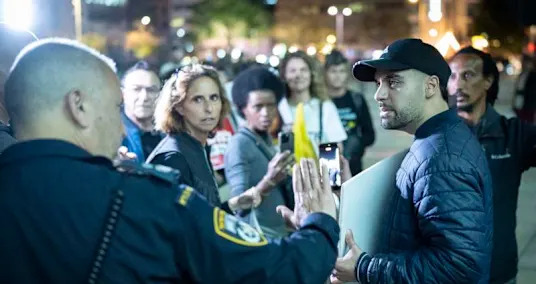
Protests took place in Tel Aviv, Jerusalem, Haifa, and Beersheba, as a survey found broad but uneven support among Jewish Israelis for Operation Roaring Lion.
Israel Police arrested 21 anti-war protesters Saturday night as demonstrations against the conflict with Iran expanded in multiple cities despite restrictions on public gatherings.
Protests took place in Tel Aviv, Jerusalem, Haifa, and Beersheba, with hundreds of participants reported in Tel Aviv and Jerusalem and about 100 in Haifa, marking the largest turnout since weekly demonstrations began. Authorities said 13 people were arrested in Tel Aviv and eight in Haifa.
Police said the gatherings were not approved under Home Front Command regulations that ban events with more than 50 people. Officials said the increase in turnout followed calls by groups opposing the government to protest despite the restrictions.
“During a situation assessment that took place at the scene with a Home Front Command representative… it was clarified that there was a real risk to human life and accordingly, Yarkon [precinct] police commander Tzachi Sharabi ordered the gathering to be dispersed,” police said.
Hadash-Ta’al chairman Ayman Odeh, an Arab lawmaker involved in the protests, criticized the police response, calling officers fascists “in the service of the government” and saying they were afraid of “the heroic citizens who went out, despite everything, to make their voice heard.”

Survey shows broad, uneven support for war
The demonstrations come as a March 2026 survey by the Israel Democracy Institute found broad but uneven support among Jewish Israelis for Operation Roaring Lion. Support was strongest on the Right at 87% and about half on the Left.
The survey also found that Jewish and Arab respondents largely agreed that Iran’s resilience has been stronger than expected. Most Jewish respondents said Israeli society could sustain the campaign for up to one month, while 28% said as long as needed. Arab respondents were less optimistic about how long the public could endure the conflict.
A majority of Jewish respondents said Prime Minister Benjamin Netanyahu’s decision was driven by security considerations, while most Arab respondents viewed it as political.
LATEST POSTS
- 1
 Looking for a great Thanksgiving side dish recipe? These are the crowd-pleasers the Yahoo team swears by.
 - 2Flourishing in a Cutthroat Work Market: Vocation Methodologies
- 3The Response to Independence from the rat race: Methodologies for Creating Financial momentum
- 4Muslim nations condemn new Israeli death penalty law
- 5Untamed life Safe-havens All over the Planet Offering Remarkable Creature Experiences



- Experience Is standing by: History's Most noteworthy Travelers
- Involved Vehicles for Seniors: Track down the Best Picks for Solace and Unwavering quality
- Most loved Road Food: Which One Prevails upon You?
- Blue Origin’s New Glenn rocket landed its booster on a barge at sea – an achievement that will broaden the commercial spaceflight market
- Taylor Swift's 'The End of an Era' docuseries: Everything you need to know, plus how to watch for less
- How grandchildren are stepping up to fill the caregiver gap
- 3 Must-Change Settings for iPhone Clients: Safeguard Yourself !
- Step by step instructions to Involve Compact disc Rates for Magnanimous Giving
- Two Israeli infants among wounded by shrapnel in overnight Iranian missile barrage